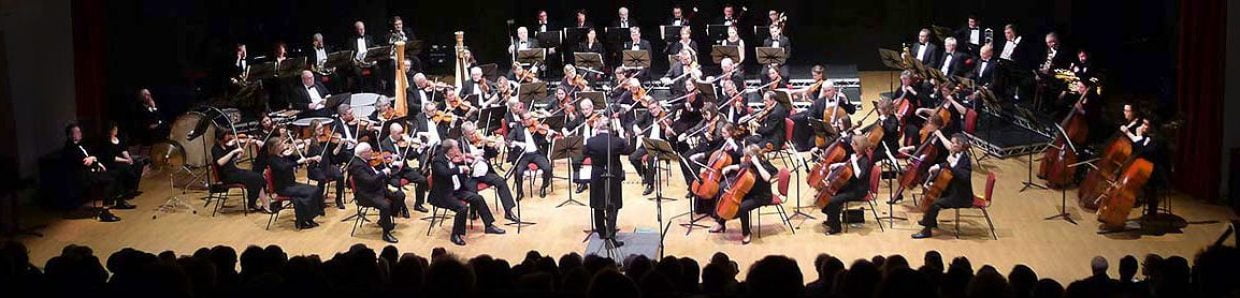
These pages contain programmes and recordings of most of our recent performances. In addition, a list of every piece we have performed since 1960 is on the repertoire page and a history of the orchestra is on the about page.
Many of the sound recordings in this archive were recorded by students on the Tonmeister course at the University of Surrey, for which we are very grateful. Note that explicit approval is required for any photography or recordings, since we must have the consent of everyone involved and pay any extra fees incurred.
Click the programme covers to download the complete programme in PDF format. You can use a browser plugin such as Video & Audio Downloader to download audio and video recordings (start playing the recording to make it appear in the list).
Saturday 9th March 2024 at 19:30
Debussy Jeux Bizet L’Arlésienne Bizet’s L’Arlésienne Suites are a crowd- pleasing mix of Gallic charm, Provençal folksong and hits from The Pearl Fishers. They follow Debussy’s fleet-footed, subtle and alluring Jeux, and Franck’s poignant and ultimately triumphant D Minor Symphony. | |||||||||
Saturday 20th January 2024 at 19:30
Walton Violin Concerto Tchaikovsky Symphony 5 The ‘victory through strife’ of Tchaikovsky’s iconic Fifth is probably the stand-out here, but Rawsthorne’s characterful Street Corner Overture opens the show, with Walton’s most luscious concerto (for violin) in the middle. | |||||||||
Saturday 11th November 2023 at 19:30
Rachmaninov Piano Concerto No. 4 Debussy Prélude à l’après-midi d’un faune Dvořák Symphony No. 5 An evening of wonderfully varied textures, with Berlioz’s effervescent Béatrice et Bénédict balanced by Rachmaninov’s jazz-influenced Fourth Piano Concerto and Debussy’s languorous Prélude à l’après-midi d’un faune. Dvořák’s tuneful Fifth Symphony forms the finale. | |||||||||
Saturday 13th May 2023 at 19:30
Delius Violin Concerto Sibelius Symphony 6 Sibelius Karelia Suite Dvořák’s Scherzo Capriccioso, Delius’ sunny violin concerto, and Sibelius’ masterful Sixth form our season finale – with ‘Last Night of the Proms’ favourite Karelia Suite as encore. This season’s concerts are supported by the generosity of the ESG Robinson Charitable Trust. Dvořák Scherzo Capriccioso
Delius Violin Concerto Sibelius Symphony 6 Sibelius Karelia Suite | |||||||||
Saturday 11th March 2023 at 19:30
Steel Kent Invicta Tchaikovsky Francesca da Rimini In our third concert, Beethoven’s beloved Sixth (‘Pastorale’) Symphony is preceded by the final work from our composition competition, and by Tchaikovsky’s lusciously romantic symphonic fantasy – Francesca da Rimini. This season’s concerts are supported by the generosity of the ESG Robinson Charitable Trust. | |||||||||
Saturday 21st January 2023 at 19:30
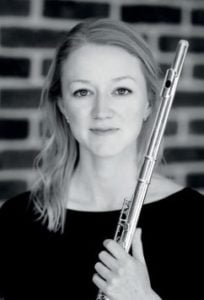
Mahler Symphony 6 Mahler’s awe-inspiring Sixth – of which Berg wrote, ‘There is only one Sixth, Beethoven’s notwithstanding’ – forms the backbone of our second concert. The brilliant Amy Yule, principal flute in the Hallé, is showcased in the Brahmsian Reinecke flute concerto. This season’s concerts are supported by the generosity of the ESG Robinson Charitable Trust. | |||||||||
Saturday 12th November 2022 at 19:30
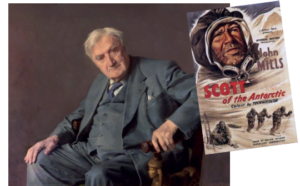
Elgar Cello Concerto Vaughan Williams Sinfonia Antartica
Supported by the Vaughan Williams Charitable Trust | |||||||||
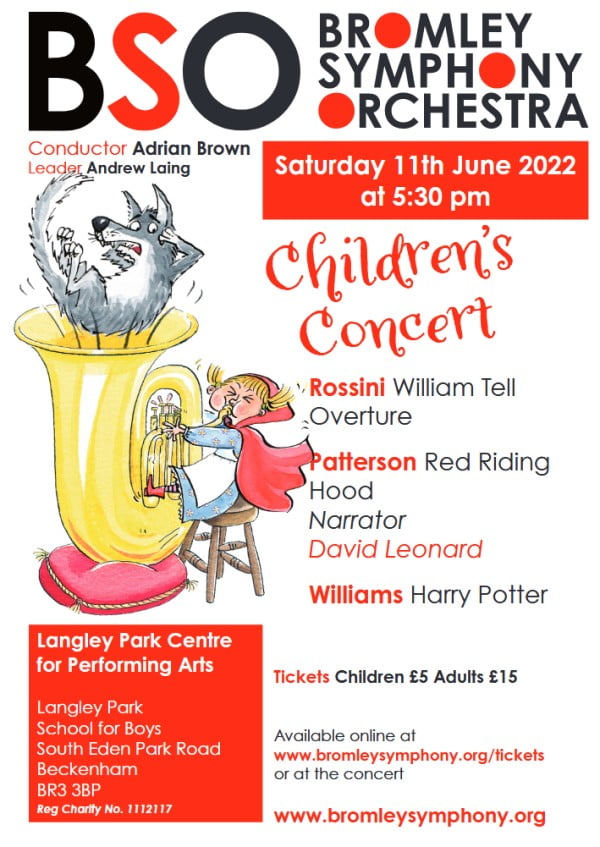
Saturday 11th June 2022 at 17:30
As a bonus, our children’s concert features Rossini’s lively “William Tell” overture, themes from the Harry Potter films, and Paul Patterson’s clever and winningly dramatic Red Riding Hood. Note: This is an additional concert, outside our regular seaon. Tickets for this concert cost £5 for under 18s, £15 for adults. | |||||||||
Saturday 14th May 2022 at 19:30
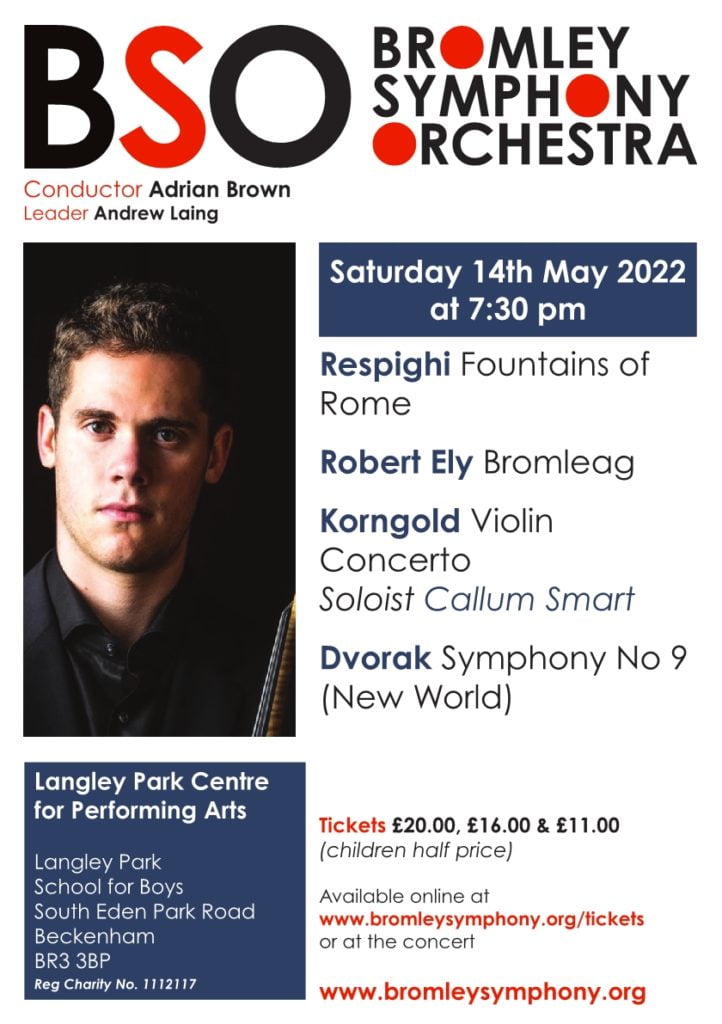
Our final concert of the 2021/22 season represents catnip for romantics: Respighi’s Fountains of Rome is followed by a ten- minute work by a finalist in our composers’ competition (Robert Ely). Afterwards, the prizewinning Callum Smart delivers Korngold’s rhapsodic violin concerto. What could possibly follow that, except for Dvořák’s “New World” Symphony? Adrian Brown interviewed about this concert on BBC radio – excerpt from The Dominic King Show 12th May 2022 | |||||||||
Saturday 12th March 2022 at 19:30
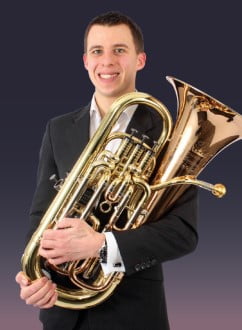
Horovitz Concerto for Euphonium Mendelssohn Overture A Midsummer Night’s Dream Bruckner Symphony No 6 In our third concert, Horovitz’s virtuosic yet engaging Concerto for Euphonium (with rising star Robbie Henderson) is framed by two overtures: Nicholai’s jovial Merry Wives of Windsor and Mendelssohn’s irresistible Midsummer’s Night’s Dream. Bruckner’s shortest and perhaps most classical symphony completes the concert. | |||||||||
Saturday 22nd January 2022 at 19:30
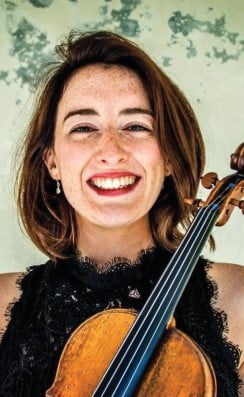
Vaughan Williams The Lark Ascending Vaughan Williams English Folk Suite Bax Symphony No 6 Redolent of the glories of the English countryside, our second concert begins with Vaughan Williams’ glittering “Wasps” Overture. We then feature the wonderful Emily Davis in the much-loved Lark Ascending (and in Longworths’ delicate tribute to the same). Bax’s gloriously powerful Sixth Symphony encompasses the second half. (“The work marches irrevocably from point to point with the inevitability of mastery.” – its first review.) | |||||||||
Saturday 13th November 2021 at 19:30
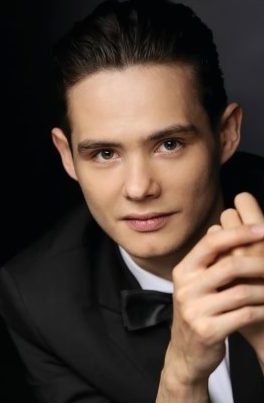
Beethoven Octet for Wind Bartók Piano Concerto No 3 Mendelssohn Scottish Symphony Our season opens with Beethoven at his grandest – Leonora Overture No. 3 – followed by Beethoven at his most intimate – his wind octet. Then the gifted Rustam Khanmurzin plays the folksong inspired Third Concerto for piano by Bartók. Mendelssohn’s scintillating Scottish symphony wraps up the concert with a Celtic flourish! | |||||||||
Saturday 17th July 2021, 17:30 and 20:00
Elgar Sea Pictures Beethoven Symphony No 5 in C Minor Socially-distanced concert with two performances in one day so as many of you can attend as possible. Tickets (for these concerts only) are priced at £15 (under 18s free but they need to “buy” a ticket). Please note that no refreshments will be served and there will be no interval. | |||||||||
Saturday 14th March 2020 at 19:30
The March concert opens with the Syrian-influenced Bacchanal by Florence Anna Maunders (from our composers competition). This is followed by Tippett’s joyful Concerto for Double String Orchestra, his most popular work, with hints of Bartók, folk idioms and the blues. Prokofiev’s Fifth Symphony concludes. (The composer: ‘a hymn to Man’s noble spirit – it filled my soul.’) Maunders – Bacchanale | |||||||||
Saturday 25th January 2020 at 19:30
Vaughan Williams Symphony No 6 Tchaikovsky 3rd Orchestral Suite Our second concert begins with Mozart’s effervescent Overture to the Magic Flute, followed by Vaughan Williams’ deeply felt Sixth Symphony. The programme concludes with Tchaikovsky’s vivid and lyrical Third Orchestral Suite. Mozart Vaughan Williams Tchaikovsky Mov 1 Tchaikovsky Mov 2 Tchaikovsky Mov 3 Tchaikovsky Mov 4 (partial) | |||||||||
Saturday 9th November 2019 at 19:30ADRIAN BROWN 40TH ANNIVERSARY CONCERT
To launch Adrian Brown’s 40th Season with Bromley Symphony Orchestra, the programme for our first concert is a repeat of Adrian’s first concert with us in 1980. Berlioz’s thrillingly vital overture Le Corsaire is followed by Brahms’ eloquent Violin Concerto, with Michael Foyle, one of the UK’s finest violinists, as soloist. The only departure from the 1980 concert is the glowing work Proem composed by John Senter, an old friend of Adrian’s, from our composers’ competition. We conclude this celebration with Sibelius’ expansive and aspirational Fifth Symphony. | |||||||||
Saturday 18th May 2019 at 19:45Centenary Finale | |||||||||
Saturday 16th March 2019 at 19:45
Reed Symphony for Strings Strauss Ein Heldenleben Elgar’s rollicking recreation of Edwardian London leads into the tuneful Symphony for Strings by his friend, the long-term LSO leader and Bromley Symphony conductor William (‘Billy’) Reed. Ein Heldenleben, Strauss’ autobiographical, lavishly romantic and richly-textured tone poem, showcases our own leader, Andrew Laing, in the second half. Reed – Symphony for Strings | |||||||||
Saturday 26th January 2019 at 19:45
Beethoven Piano Concerto No 1 in C major Mahler Symphony No 1 in D major Mozart’s small-but-perfectly-formed Symphony 32 precedes the internationally renowned John Lill, who joins us in Beethoven’s First Piano Concerto. Then, Mahler’s monumental First Symphony (the ‘Titan’), which exemplifies his comment: ‘To write a symphony is, for me, to construct a world.’ Mahler Symphony No 1 in D major | |||||||||
Saturday 10th November 2018 at 19:45
| |||||||||
Composition Competition
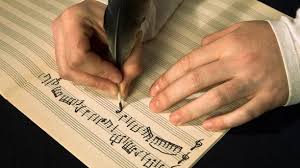
Europa by Marco Muilwijk This work will be performed as part of our May 2019 concert. We are very grateful to our adjudicator Paul Patterson for the many hours he donated to this project. The orchestra members voted for Bacchanal by Florence Anna Maunders and we will perform this in March 2020. Proem by John Senter will be performed in our November 2019 concert. We received more than 30 entries, thank you! We are very grateful for the considerable time and effort that went into preparing each of them. The other shortlisted finalists were:
The rehearsal recordings made of each of the finalist’s works are below. Europa by Marco Muilwijk Bacchanal by Florence Anna Maunders Proem by John Senter Bromleag by Robert Ely Kent Invicta by Philip Steel | |||||||||
Saturday 19th May 2018 at 19:45
Roy Harris Symphony No 3 Holst Suite ‘The Planets’ Following Bernstein’s scintillatingly offbeat overture to Candide, we present an underrated masterpiece, Harris’ magnificently energetic, occasionally brooding yet always glorious (single-movement) Third Symphony. We follow this with the mercurial Holst’s self-described ‘mood pictures’ – his Herculean tour de force, The Planets. Bernstein Overture ‘Candide’ Roy Harris Symphony No 3 Holst Suite ‘The Planets’ | |||||||||
Saturday 10th Mar 2018 at 19:45
Smetana Overture: ‘The Bartered Bride’ Tchaikovsky Violin Concerto Shostakovich Symphony No. 15 Smetana’s Bartered Bride overture is sheer orchestral effervescence – with a Slavic twist. Tchaikovsky’s eloquent violin concerto features prizewinning violinist Anna-Liisa Bezrodny on her Amati violin. The second half consists of one of Shostakovich’s quirky masterpieces, his 15th symphony. Side-swiped excerpts from William Tell in the first movement, evocative violin and cello solos and ghostly brass chorales in the second, plus a sardonic scherzo, are superseded by a finale echoing some of the most stirring moments from Wagner’s Ring and a sense of utter completion. | |||||||||
Saturday 27th Jan 2018 at 19:45
Vaughan Williams Oboe Concerto Strauss Suite from ‘Der Rosenkavalier’ Nielsen’s 3rd Symphony (the ‘Espansiva’) is light and joyous – not ‘typical’ Nielsen at all. Its famous slow movement, which Nielsen himself described as a ‘landscape Andante,’ uses offstage solo voices to marvellous effect. Vaughan Williams then provides a virtuoso showpiece for principal oboist Caroline Marwood. A folk music-inspired pastorale is followed by a delicate minuet, while the finale is almost a perpetuum mobile – interrupted by some stunningly lyrical passages. The Rosenkavalier suite excerpts moments of Strauss’ greatest masterpiece, including the ‘Presentation of the Rose’ scene, and the most richly textured of the opera’s several waltzes. It concludes with the powerful trio for the Marschallin, Octavian and Sophie – and by the languorous final duet. Not to be missed! | |||||||||
Saturday 11th Nov 2017 at 19:45
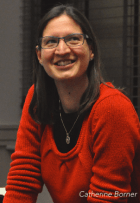
Casals arr Brown ‘Song of the Birds’ Debussy ‘Ibéria’ from ‘Images’ De Falla ‘Nights in the Garden of Spain’ Ravel ‘Boléro’ Sexy, sassy and Latin American, Márquez’s Danzón No. 2 is followed by a Spanish folk miniature for solo cello and orchestra. Then we get into the meat of the concert. Debussy’s ‘Ibéria’ – impressionistic and evocative – reminds us of his comment: ‘Music is as boundless as the elements, the wind, the sky, the sea… ’ De Falla himself acknowledged Debussy’s achievement: ‘the intoxicating spell of Andalusian nights, the joyous strains of guitars and bandurrias, whirls in the air!’ De Falla’s own Nights in the Gardens of Spain follows (‘the most tragic and sorrowful of his works, expressing an intimate and passionate drama.’) Catherine Borner’s piano solos are woven within a flamboyant orchestral texture. We conclude with Ravel’s iconic Boléro – by far his most famous work.(At its premiere, a woman furiously objected that Ravel must be mad. Ravel’s comment? ‘She has understood the piece!’) A barn-storming finale! A good quality video of this concert exists (all 5 pieces, no announcements, 74 minutes approx), recorded in high definition using three cameras and edited by Chris Beston. DVDs (standard definition, £8) and Blu-ray discs (high definition, £12) are for sale in the foyer on concert days or can be ordered through our contact page. Márquez – Danzón No.2 Casals – Song of the Birds Debussy – Ibéria De Falla – Nights in the Garden of Spain Ravel – Boléro | |||||||||
Saturday 20th May 2017 at 19:45
Debussy: Rapsodie pour orchestre et saxophone Brahms: Symphony No. 2, Op. 73 Dukas suggested that his La Péri should evoke ‘translucent, dazzling enamel’ with hints of Persia. Debussy’s Spanish-inspired Rhapsody for saxophone and orchestra is followed by Brahms’ radiantly sunny, transcendently lyrical Second Symphony. See you there! | |||||||||
Saturday 18th March 2017 at 19:45
Schumann: Symphony No. 2, Op. 61 Mahler: Das Lied von der Erde Schumann’s affirmatory Second Symphony precedes Mahler’s orient-inspired masterpiece, in which international artists Janice Watson and John Upperton take us on a journey from heroic energy through autumnal lament to a gloriously existential farewell. 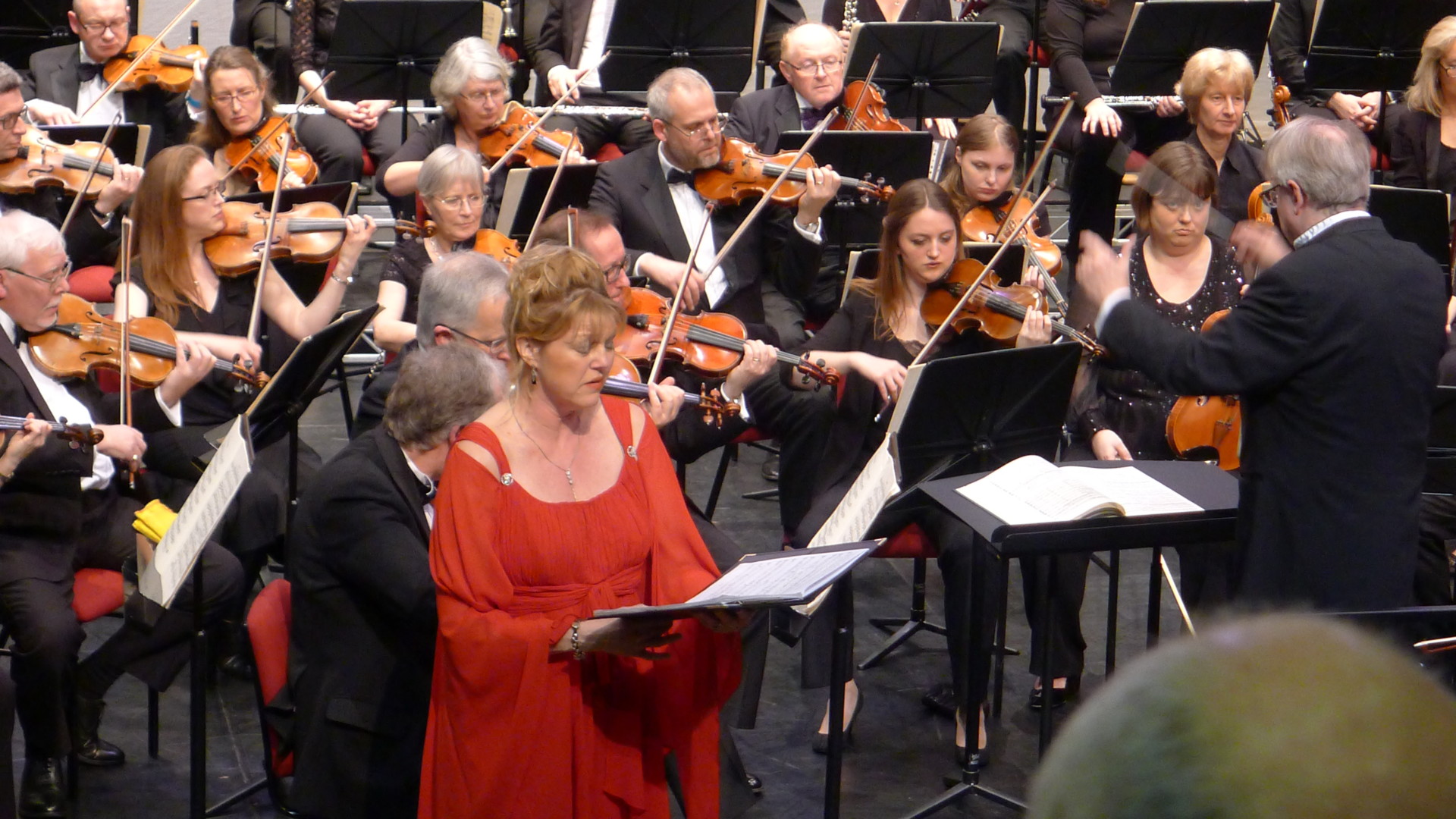  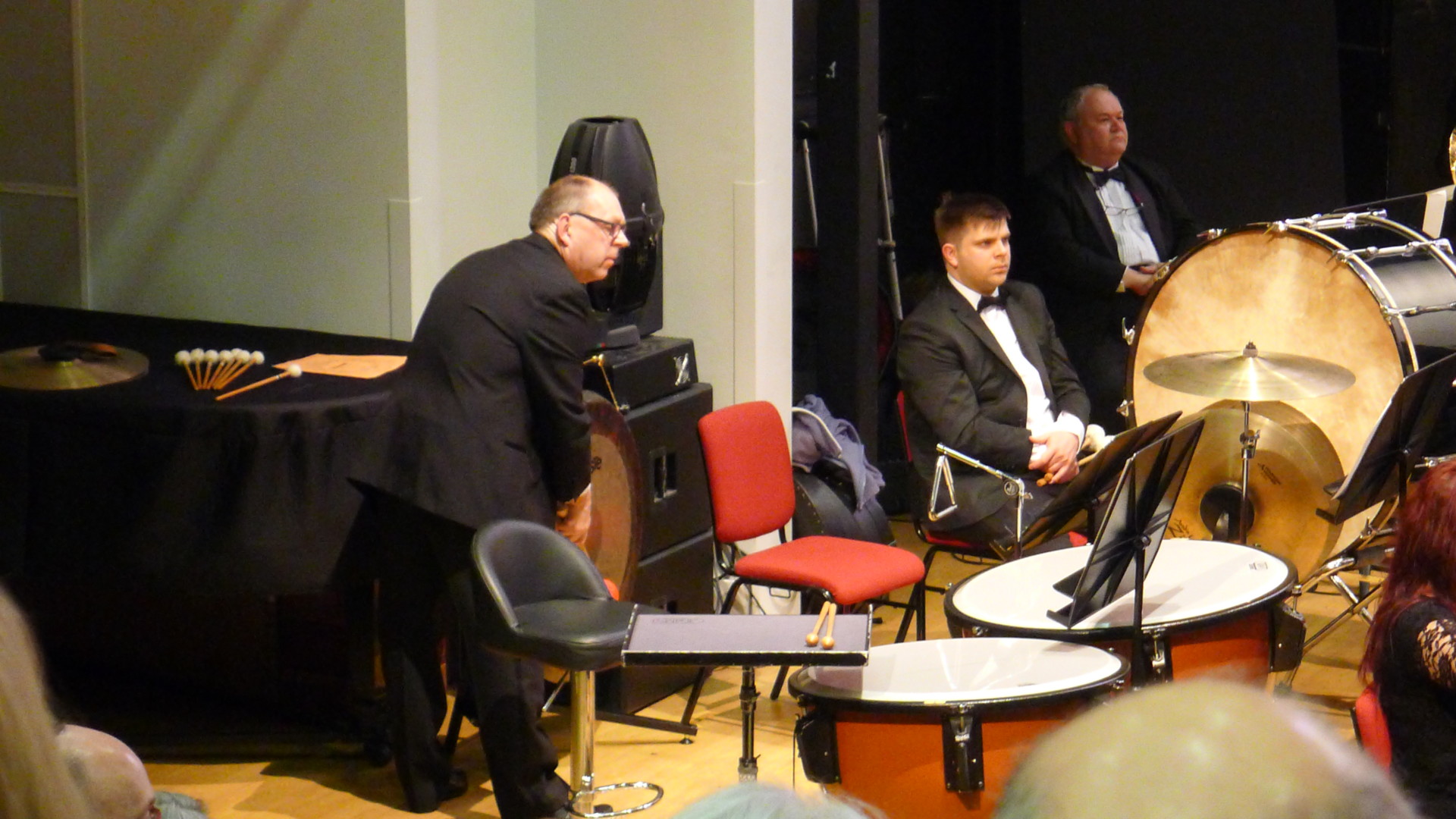        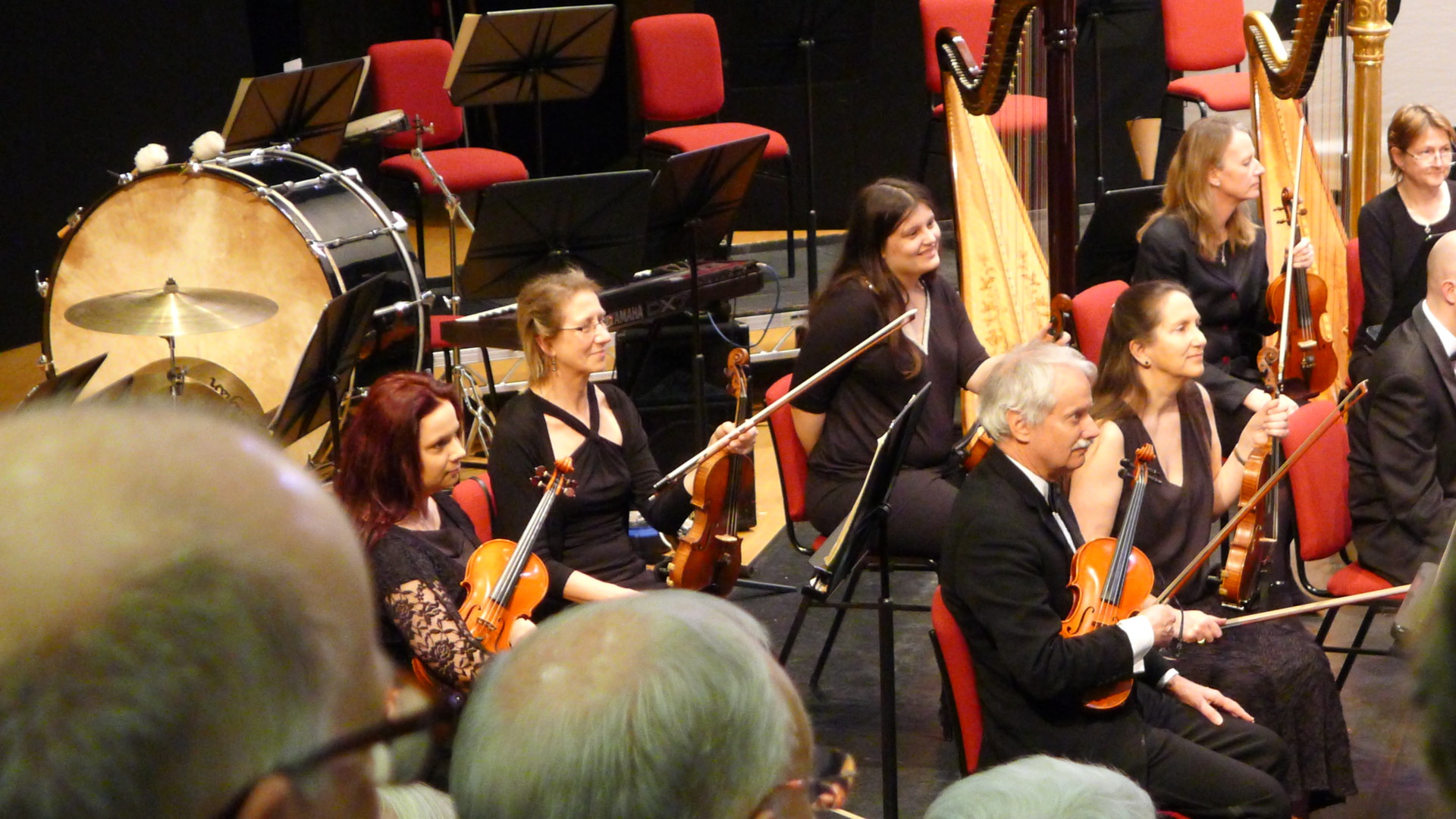  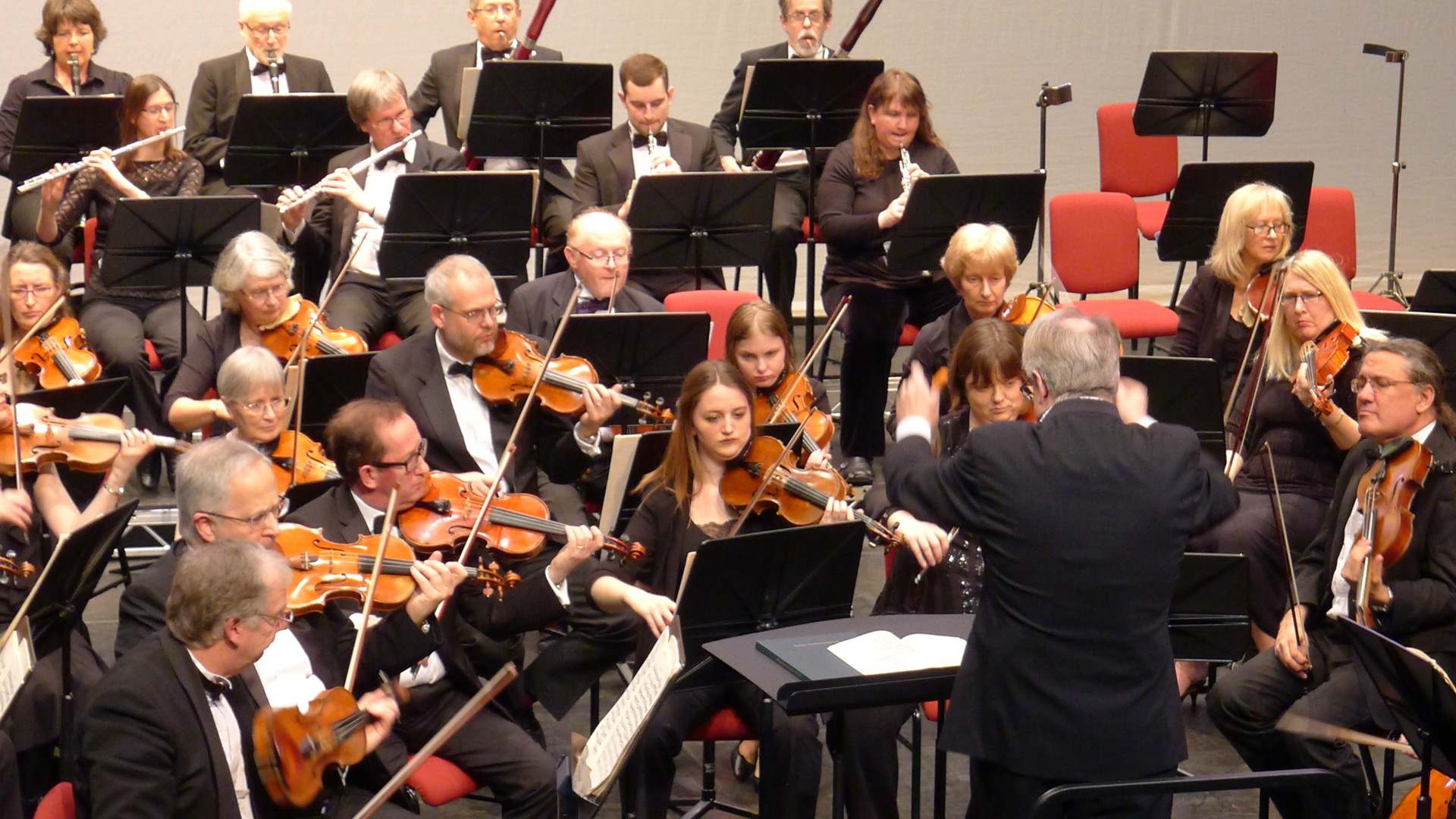  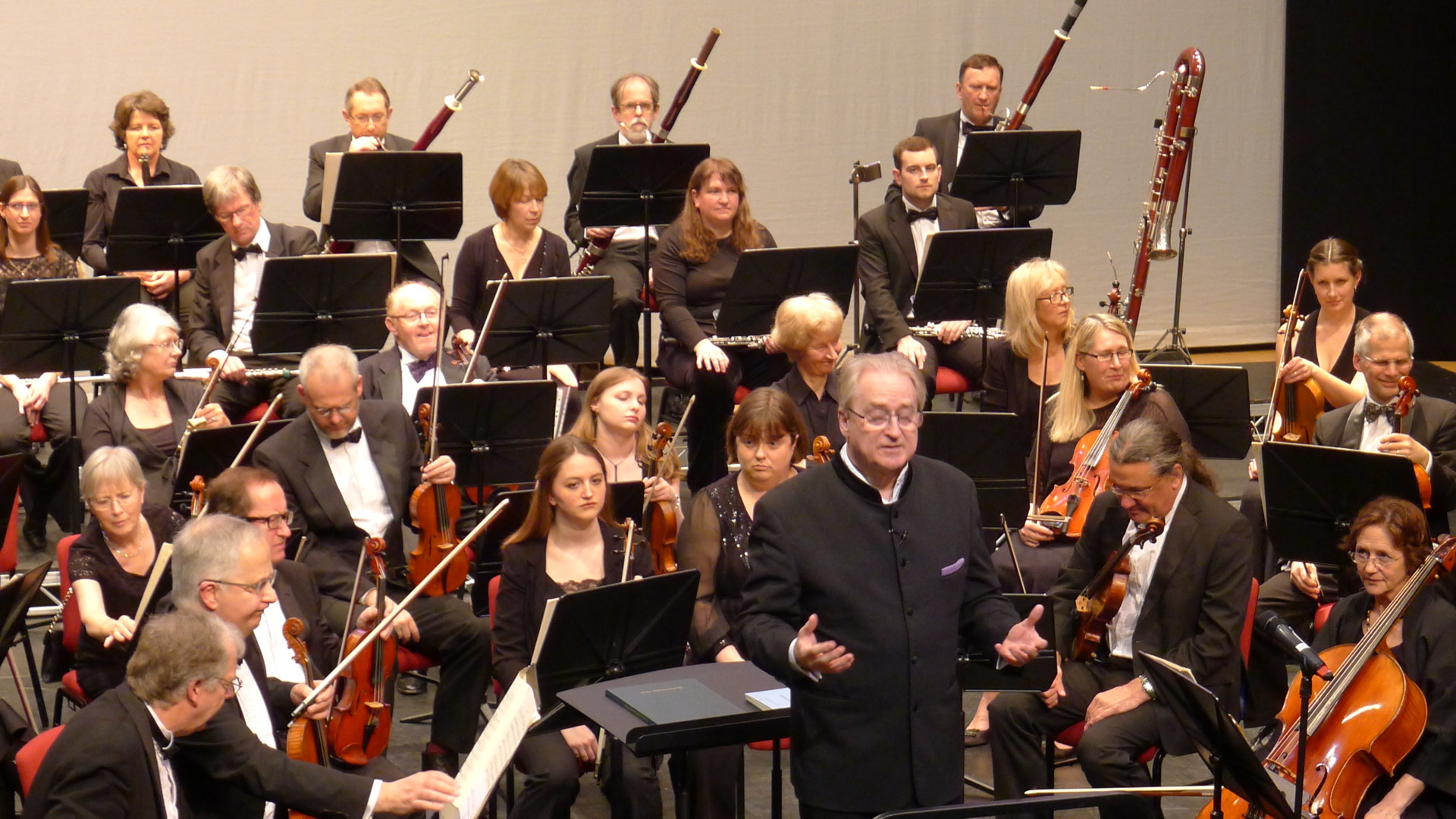    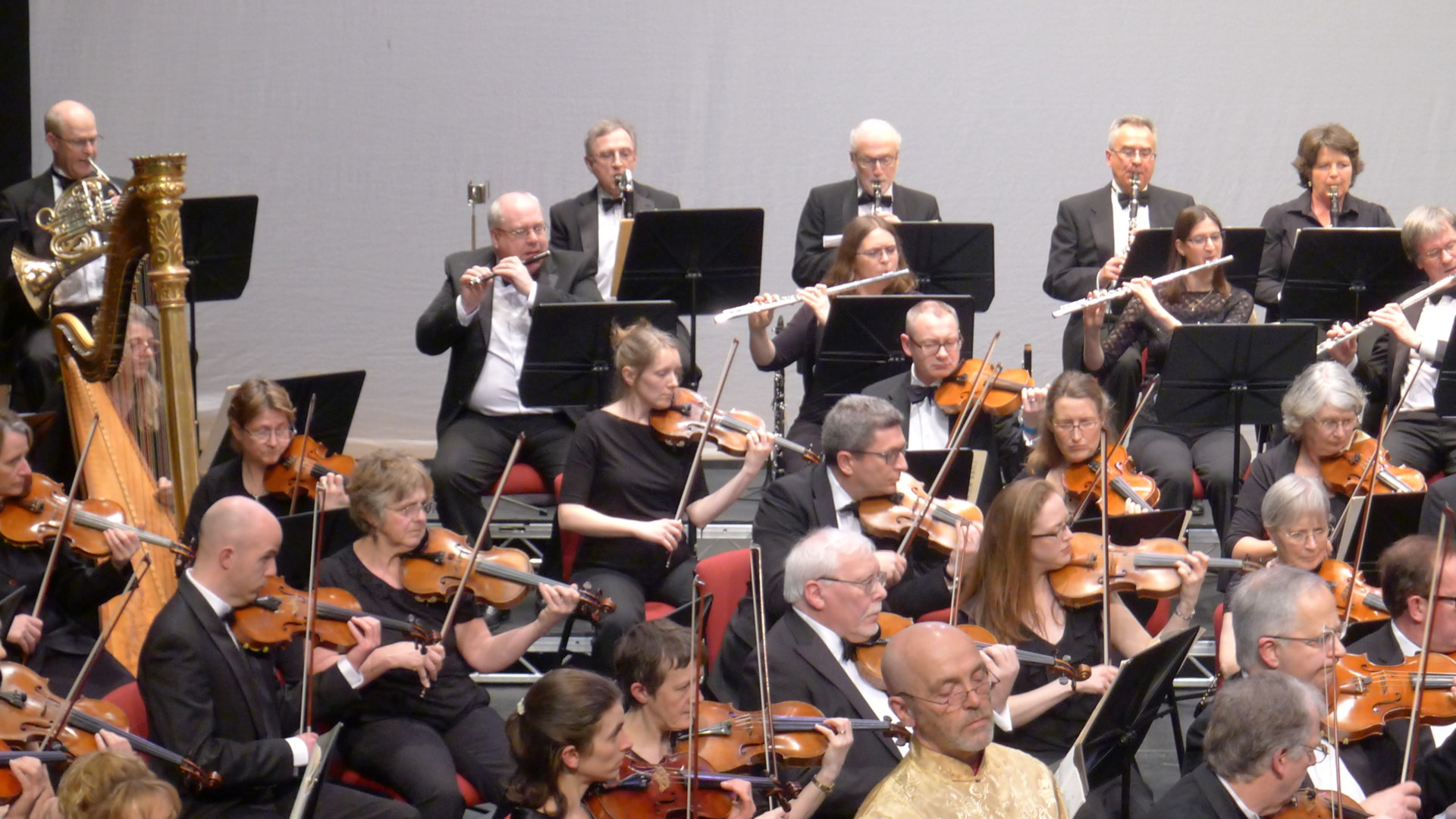  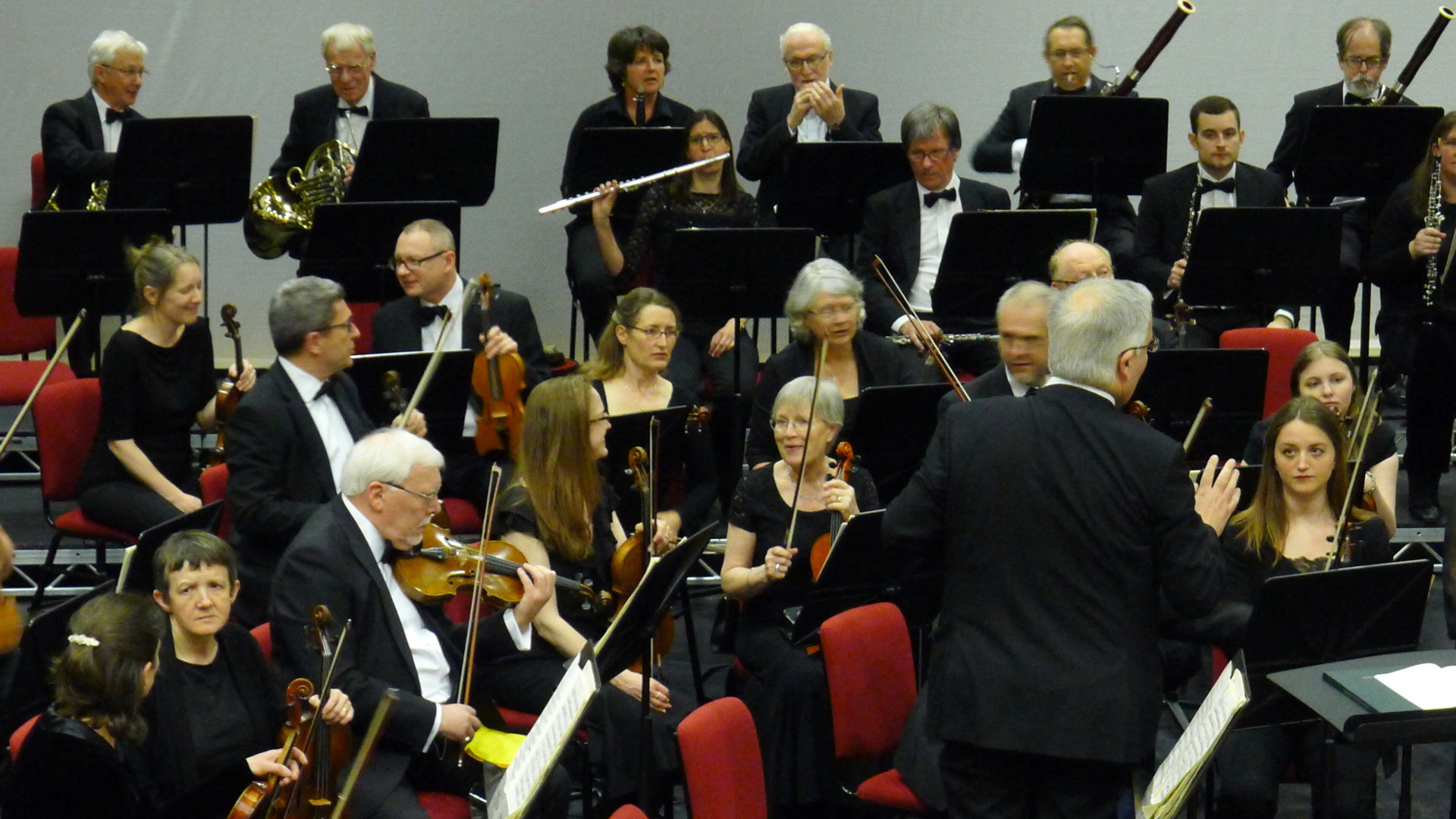    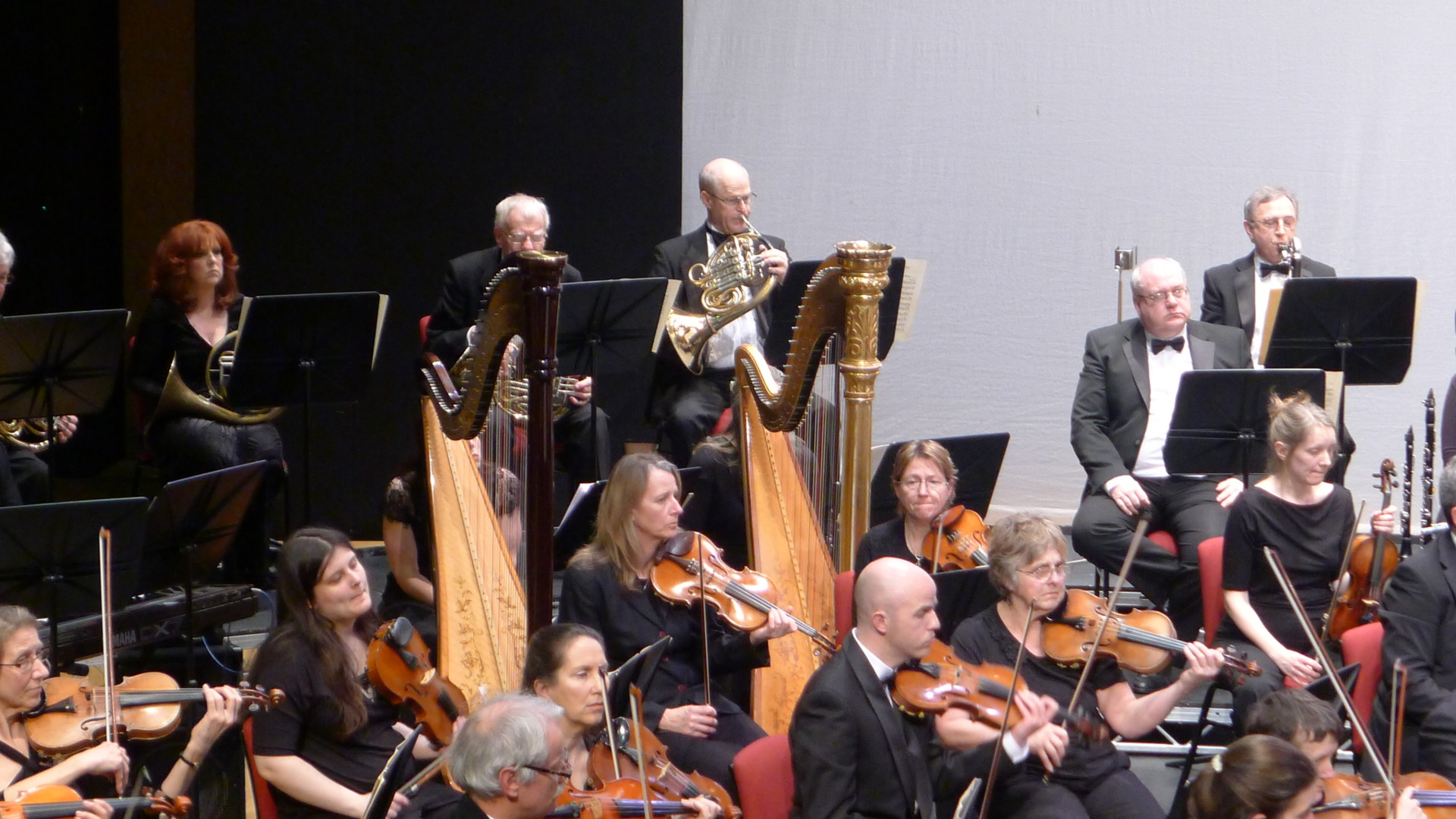  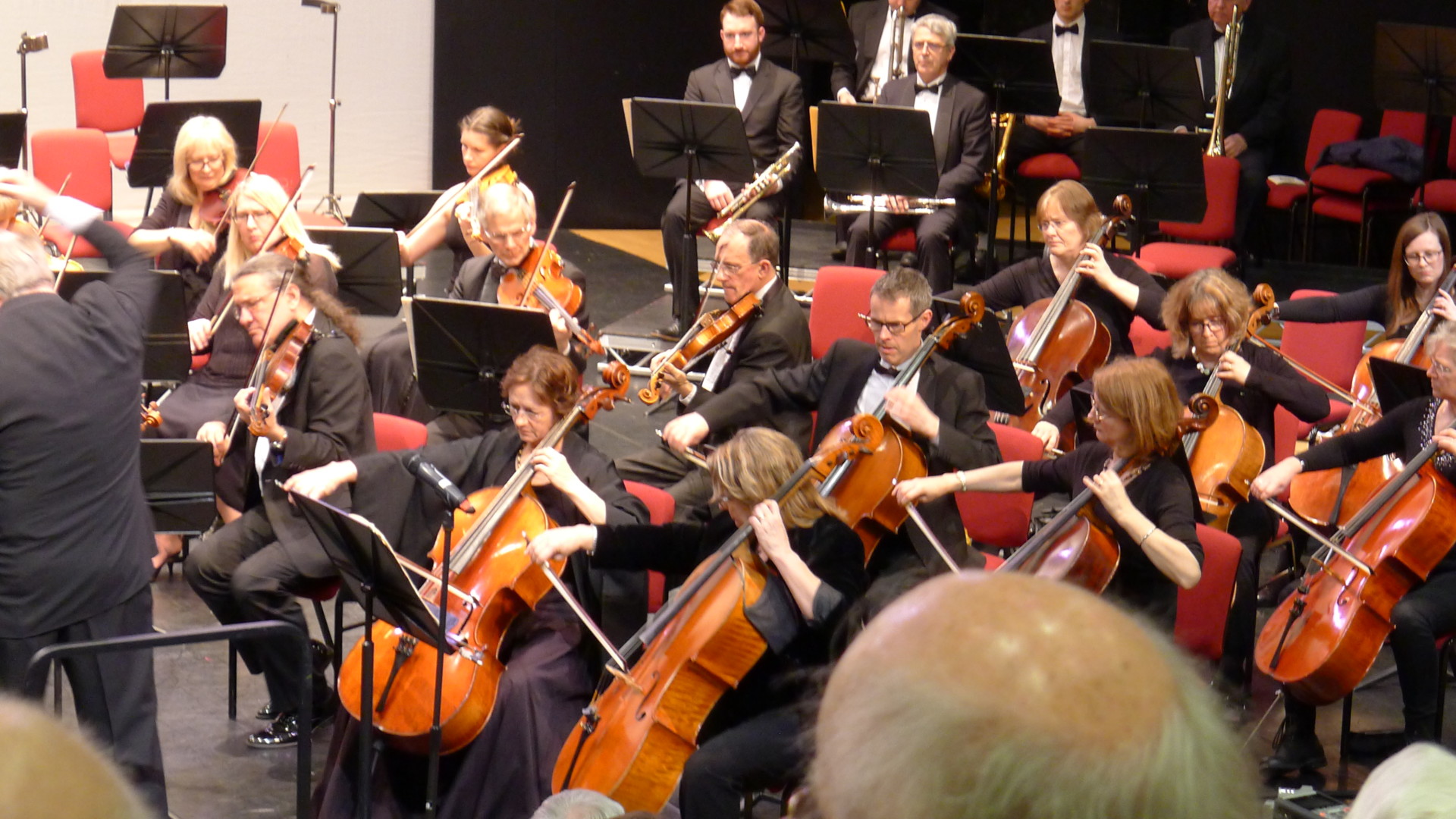      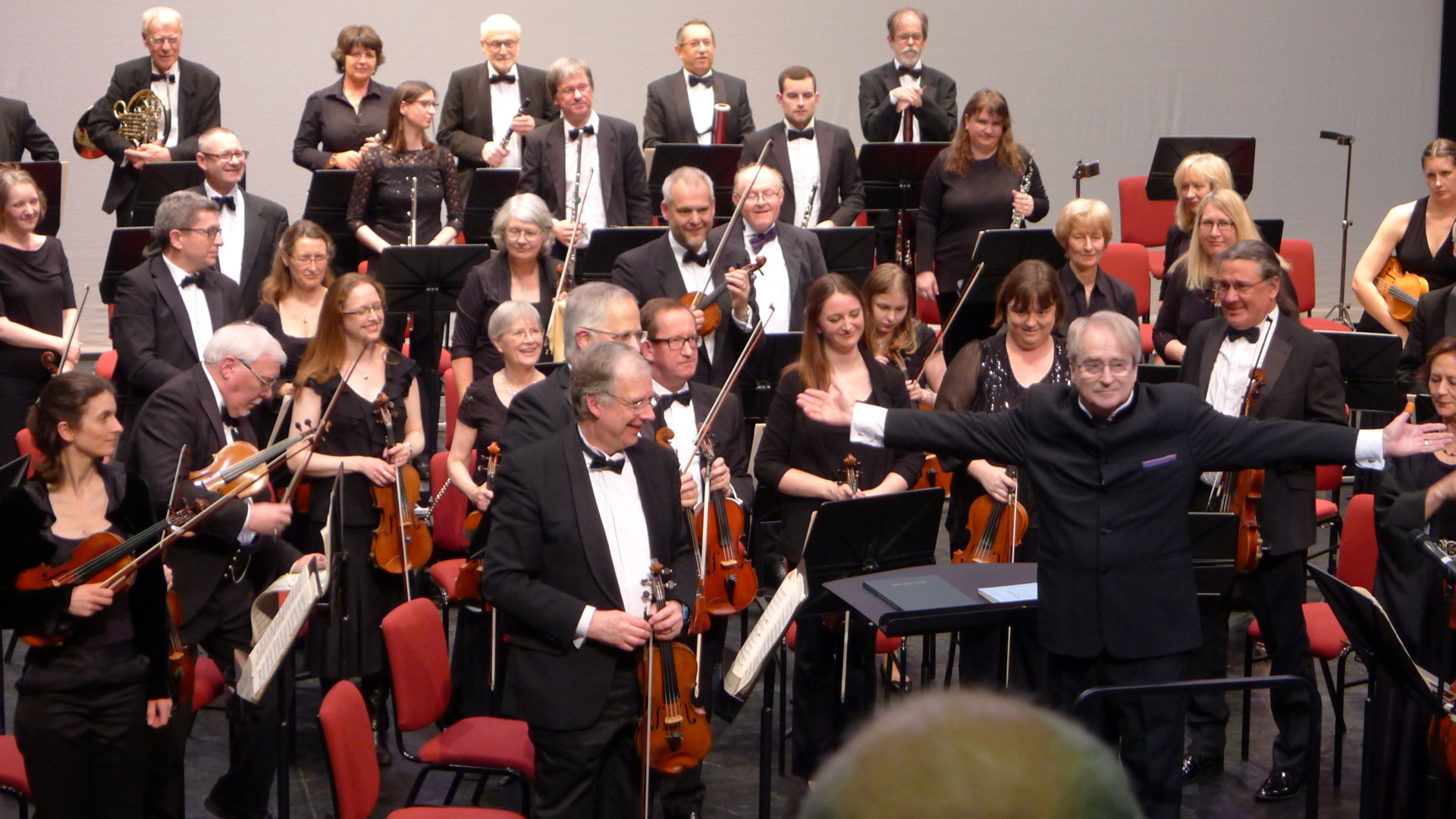  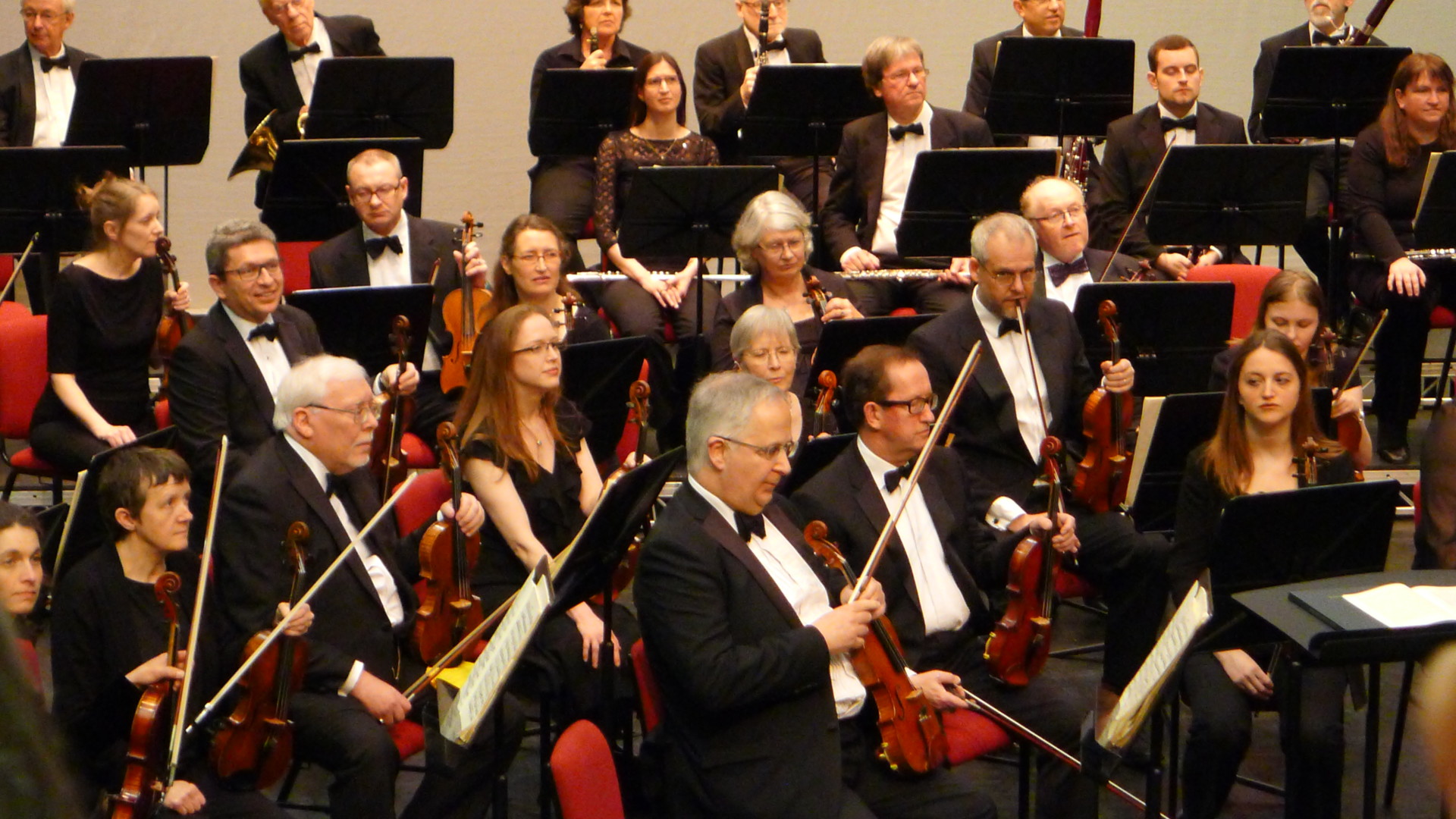    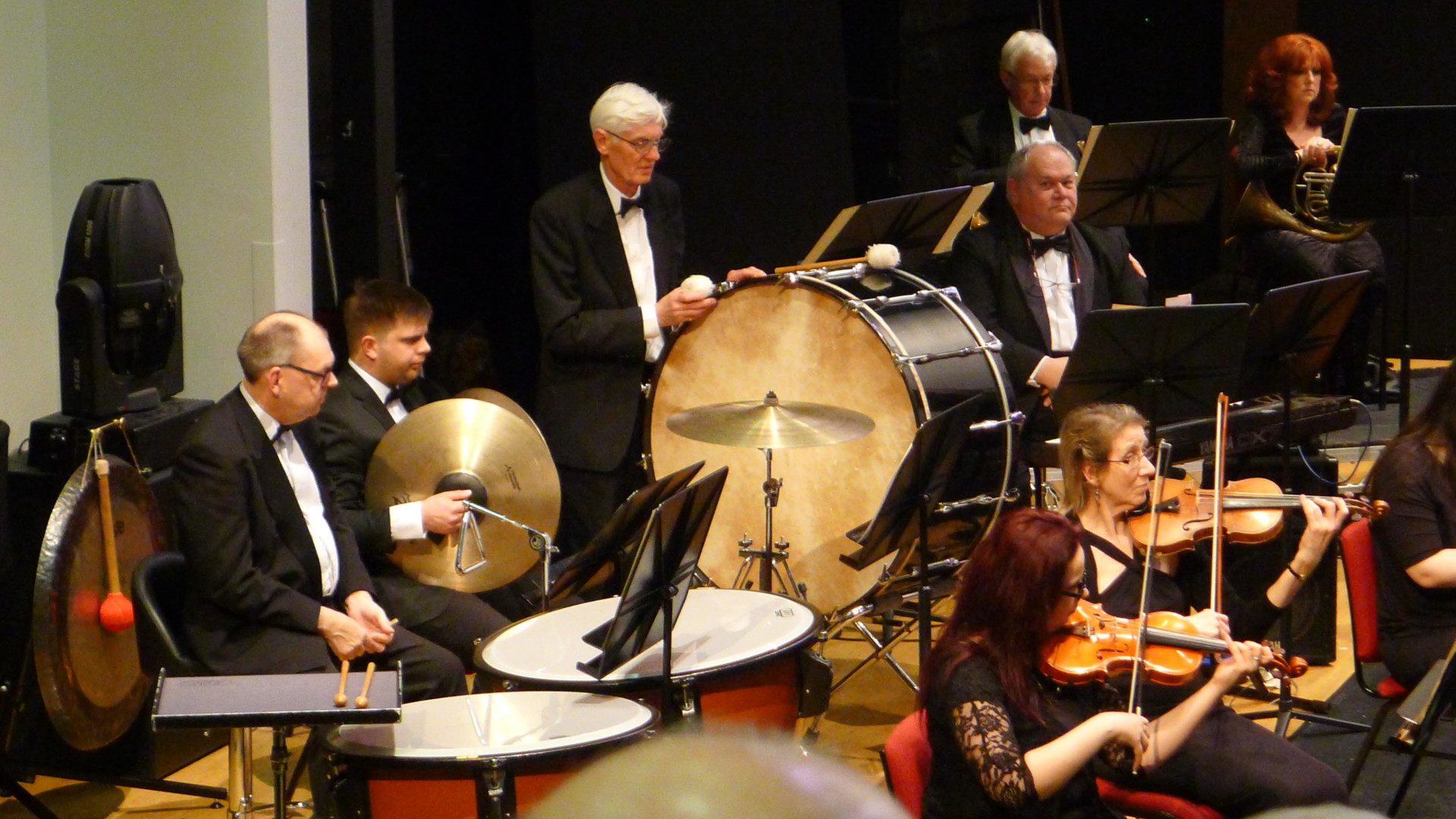  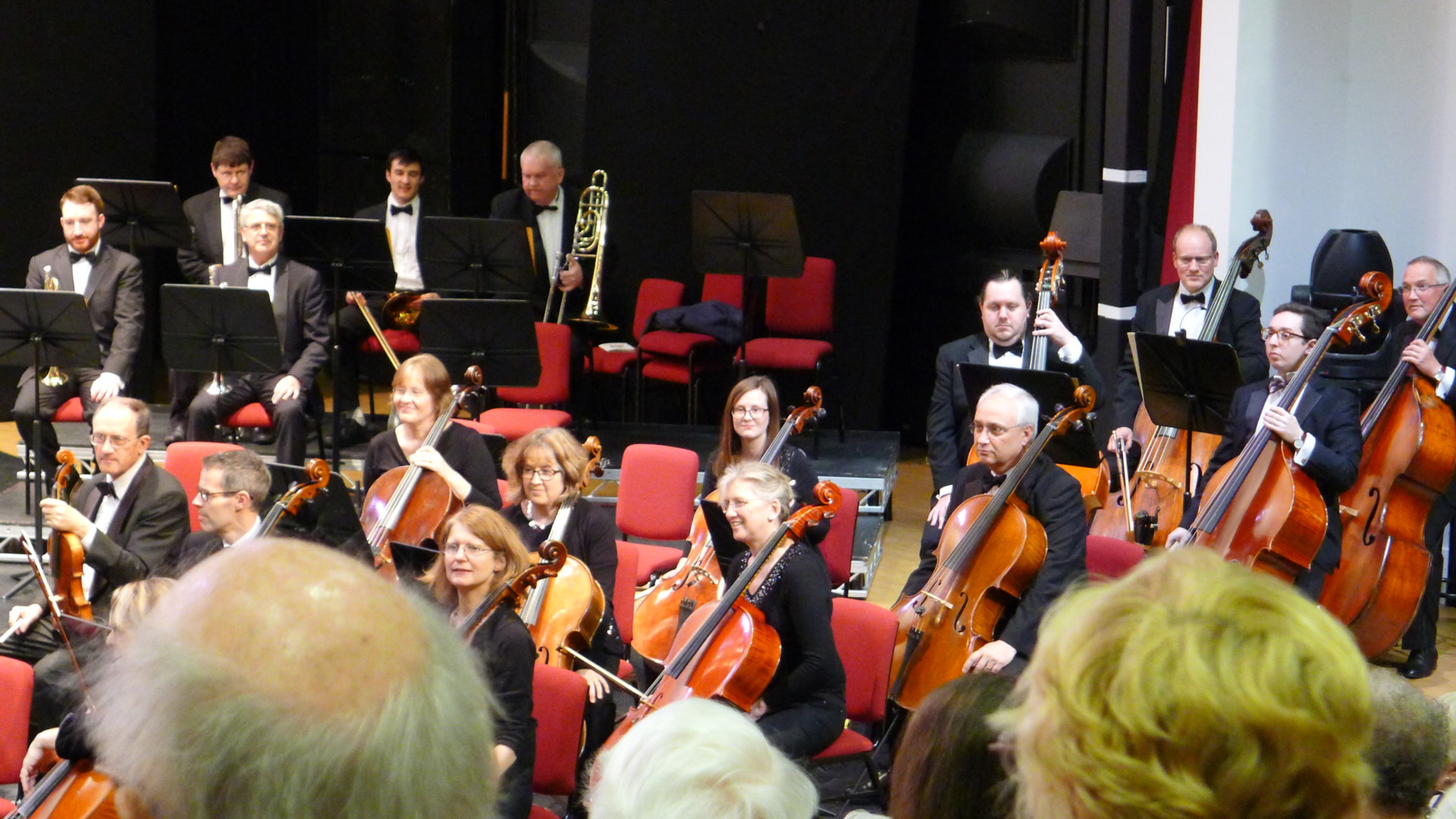  | |||||||||
Saturday 21st January 2017 at 19:45
Ireland: A London Overture Rachmaninov: Piano Concerto No. 3, Op. 30 Bliss: A Colour Symphony Ireland’s vibrant London Overture is coupled with Rachmaninov’s rhapsodic and virtuosic Third Piano Concerto, starring Masa Tayama. Arthur Bliss’ exuberantly dashing ‘Colour’ symphony – one of the great British masterpieces of the 20th century – spins its magic in the second half. | |||||||||
Saturday 12th November 2016 at 19:45
Berlioz: Overture ‘King Lear’ Op. 4 Debussy: Danse sacrée et Danse profane Ravel: ‘Daphnis et Chloé’ Ballet Our French first concert opens with Berlioz’ mercurial and richly programmatic King Lear. Harpist Elizabeth Scorah features in Debussy’s dreamily evocative Danse sacrée et Danse profane, followed by Ravel’s masterpiece of which he wrote: ‘Sumptuous and subtle, I have created the Greece of my dreams.’ | |||||||||
Saturday 21st May 2016 at 19:45
Prokofiev Symphony No. 7 in C# minor, Op. 131 Arutiunian Trumpet Concerto in A-flat major Soloist Martin Bunce Borodin In the Steppes of Central Asia Tchaikovsky ‘1812’ Overture, Op. 49 The final concert of this season features four short classics. In the first half, Prokofiev’s seventh symphony is teamed with Arutiunian’s dashing trumpet concerto – featuring our own trumpet principal, Martin Bunce. Afterwards, Borodin’s pint-sized tone poem ‘In the Steppes of Central Asia’ is followed by the careering fire, stirring drums and wild cannon of Tchaikovsky’s ‘1812’ Overture. See you there! | |||||||||
Saturday 19th March 2016 at 19:45
Bruckner Symphony No. 9 in D minor Our third concert of the season features another clever piece of programming: Schubert’s delightfully winning Symphony No 5 is followed by Bruckner’s shortest symphony: his seismic, turbulent and (finally) transcendent Ninth Symphony. | |||||||||
Saturday 23rd January 2016 at 19:45
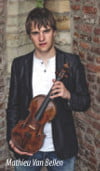
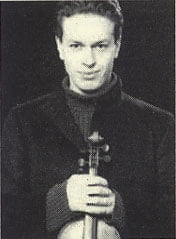
Sibelius Symphony No. 4 in A minor, Op. 63 Beethoven Violin Concerto in D major, Op. 61 Soloist Mathieu van Bellen Beethoven takes pride of place in our second concert: his powerful ‘Prometheus’ Overture and his fabulous violin concerto frame Sibelius’ moodily brilliant Symphony No 4. We are delighted to once again feature rising star Mathieu van Bellen and his Guadagnini violin, this time in one of Beethoven’s most iconic works.
| |||||||||
Saturday 14th November 2015 at 19:45
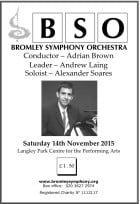
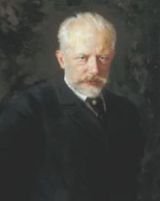
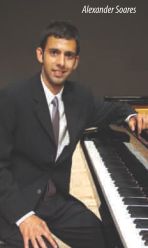
Grieg Piano Concerto in A minor, Op. 16 Soloist Alexander Soares Tchaikovsky ‘Manfred’ Symphony in B minor, Op. 58 We open the season with two ‘takes’ on the romantic period pin-up, Manfred: Schumann’s broodingly magnificent ‘Manfred’ overture and Tchaikovsky’s rich and dramatic ‘Manfred’ symphony. In between we feature serial international prizewinner Alexander Soares in Grieg’s endlessly tuneful piano concerto. Not to be missed!
| |||||||||
Concert Saturday 16th May 2015 at 19:45
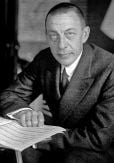
Strauss Serenade for Thirteen Wind Instruments in E flat Glazunov Violin concerto in A minor Rachmaninov Symphonic Dances This concert consists of four brief and delightfully contrasting works. Humperdinck’s tuneful overture to Hansel and Gretel gives way to Richard Strauss’ charming chamber serenade for thirteen wind instruments and Glazunov’s scintillating violin concerto (starring previous Young Musician of the Year violin winner Callum Smart). Rachmaninov’s Symphonic Dances (a very late work) winds up the evening in sardonic, sensual style. | |||||||||
Concert Saturday 21st March 2015 at 19:45
Mahler Symphony No. 7 Not to be missed is our third concert, comprising Mahler’s stunning Seventh Symphony, written at the height of his success as conductor and composer, and exemplifying his famous quotation: ‘A symphony must be like the world; it must contain everything.’ The seventh is rightly reckoned rather enigmatic, but contains, after a funeral march, the exquisite ‘night music’ movements and a demented waltz of a scherzo, an exultant climax. | |||||||||
Concert Saturday 24th January 2015 at 19:45
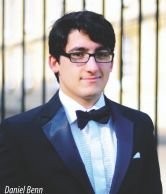
Dvořák Cello Concerto in B minor Raine Memories of a Dream Brahms Symphony No. 3 in F major Nineteenth-century Romanticism is hugely to the fore for our second concert, kicking off with the Dvořák, the world’s best-known and best-loved cello concerto, performed by the gifted young soloist Daniel Benn in memory of his grandfather, Tony Benn. After the interval the orchestra performs Brahms’s Third Symphony, a masterpiece written in a mere four months, of which Clara Schumann wrote to Brahms on February 11, 1884: ‘All the movements seem to be of one piece, one beat of the heart.’  Many thanks to Ian Gillett, Steve Belgrave and Lester Barnes for photographing and recording the rehearsal and performance. Dvořák Cello Concerto – Allegro Dvořák Cello Concerto – Adagio Dvořák Cello Concerto – Finale Jonathan Raine: Memories of a Dream Brahms: Symphony No. 3 Allegro con brio Andante Poco allegretto Allegro – Un poco sostenuto | |||||||||
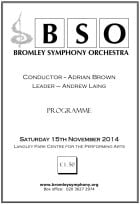
Concert Saturday 15th November 2014 at 19:45
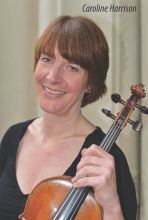
Walton Concerto for Viola and Orchestra Elgar Symphony No. 1 in A-flat major Our opening concert showcases outstanding British composition. From the light, jazzy Portsmouth Point, with its swaggering brass and pointed off-beats, to Walton’s resonant, lyrical and eloquently full-throated viola concerto, featuring Caroline Harrison, principal viola of the BBC Symphony Orchestra, the concert winds up with Elgar’s immortal First Symphony, of which its first conductor, Hans Richter said to his orchestra, ‘Let us rehearse the greatest symphony in modern times.’ | |||||||||
Concert Saturday 17th May 2014 at 19:45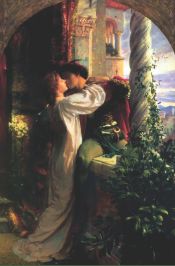
Bernstein Symphonic Dances from West Side Story Tchaikovsky Romeo and Juliet Overture We end our season with three very different works depicting Shakespeare’s Romeo and Juliet. Tchaikovsky’s sublime fantasy overture weaves the main themes of the story into twenty minutes of orchestral perfection. In West Side Story, Leonard Bernstein transplants the two doomed lovers to jazzy 1950’s New York. His Symphonic Dances leave the listener breathless as they are shamelessly bombarded with many of the twentieth century’s best tunes, including ‘Maria’, ‘America’ and ‘Cool.’ Berlioz was equally inspired, especially by his wife-to-be’s performance as Shakespeare’s Juliet. His ‘take’ on the work is bursting with harmonic imagination, fervent power, eloquent emotion and frustrated desire. Berlioz: Roméo et Juliette Bernstein: West Side Story Tchaikovsky: Romeo and Juliette | |||||||||
Concert Saturday 22nd March 2014 at 19:45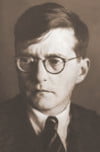   Shostakovich Symphony No. 6 Mussorgsky Pictures at an Exhibition Shostakovich’s 6th symphony, conceived in the 1930s, is a very personal work, reflecting not only the suffocating oppression of the Stalinist era but also the resilient spirit of the composer, with the power of the first movement balanced by the defiant and even riotous flair of the following two. Mussorgsky’s famous Pictures at an Exhibition was composed within a single month for piano, and has never slipped from orchestral repertoire since Ravel (among others) arranged it and it is Ravel’s orchestration we will be playing. Listen to the spooky ‘Catacombs’, enjoy the gossip from ‘The Market of Limoges’ and thrill to the grandeur of the final ‘Great Gate of Kiev.’ | |||||||||
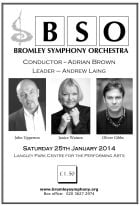
Concert Saturday 25th January 2014 at 19:45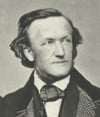
Wagner Die Walküre, Act 1 If you think you know Haydn, come and hear Symphony No. 103 (‘The Drumroll’), one of the famous late symphonies composed when Haydn was the toast of London. Symphony No. 103 is one of his most interesting, being packed with originality, pathos and wit. Following this, we are extraordinarily fortunate to be joined by internationally-known singers Janice Watson, John Upperton and Oliver Gibbs to perform Act 1 of Die Walküre, the second part of Wagner’s famous ‘Ring’ cycle. Controversially, some of us think that this is the most enjoyable way of playing Wagner. See what you think!  Janice Watson  John Upperton 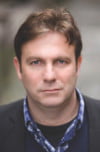 Oliver Gibbs | |||||||||
Concert Saturday 16th November 2013 at 19:45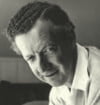
Britten Violin Concerto Wagner Die Meistersinger von Nürnberg, Act 3 Prelude Beethoven Symphony No. 7 Beethoven described his seventh symphony as ‘one of my best’, a view shared by audiences who demanded an encore of the second movement on its début performance. Wagner famously described it as ‘the apotheosis of the dance.’ Young Dutch virtuoso Mathieu van Bellen assists us to mark the centenary of the birth of Benjamin Britten with a performance of his violin concerto, which was inspired by Beethoven’s. Here economy of material is illuminated by virtuosic violin writing and scintillating use of orchestral tone colour. The brilliant overture to Die Meistersinger von Nürnberg delivers the complete opera in miniature; all the main themes are there. We add the atmospheric prelude to Act 3 to launch a season celebrating the 200th anniversary of Wagner’s birth. | |||||||||
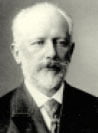
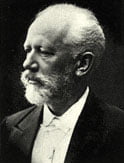
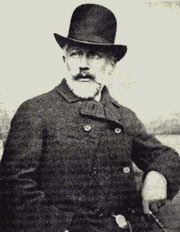
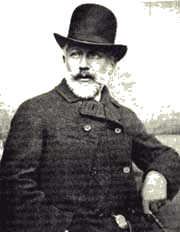
Concert Saturday 18th May 2013 at 19:45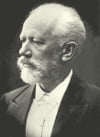 Piotr Tchaikovsky
Khachaturian Violin concerto Tchaikovsky Symphony No. 6 (Pathétique) The final concert of our season opens with the brilliant Festive Overture, a vivacious musical firework. Khachaturian’s concerto is a magnificent whirlwind of powerful emotions and unbridled energy. The Pathétique is a complex mixture of emotions – sorrow, hope, and happiness tinged with a foreboding of despair – a mixture that has ensured its enduring popular appeal. | |||||||||
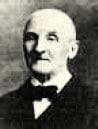
Concert Saturday 16th March 2013 at 19:45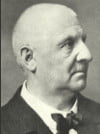 Anton Bruckner
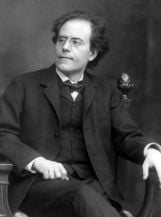
The Eighth Symphony is a monumental work, full of the composer’s characteristic ‘trade marks’ but taking them further than ever before: a mysterious opening, dramatic climaxes and contrasts, a lively dancing scherzo, a heartfelt slow movement – he believed it was his best one – and finally a very powerful finale which brings it all together in a glorious blaze of triumph. Allegro moderato Scherzo. Allegro moderato – Trio, langsam Adagio. Feierlich langsam, doch nicht schleppend Finale. Fierlich, nicht schnell | |||||||||
Concert Saturday 26th January 2013 at 19:45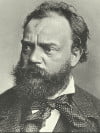 Antonin Dvořák
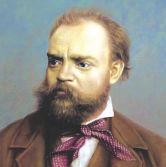
Suk Fairy Tales Mahler Rückert Lieder Dvořák Symphony No. 7 Suk’s Fairy Tale is a colourful suite of four movements drawn from music he wrote for a theatre piece. Mahler’s set of five songs, based on poems by Friedrich Rückert, share a mood of intimacy and quiet withdrawal. The Seventh Symphony, dramatic and darkly passionate and expressing the defiance of the underdog, is perhaps Dvořák’s greatest. | |||||||||
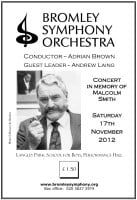
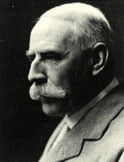
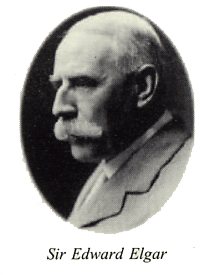
Concert Saturday 17th November 2012 at 7:45pmConcert dedicated to the memory of Malcolm Smith 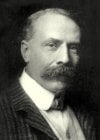 Sir Edward Elgar
Elgar Cello concerto Vaughan Williams Symphony No. 2 (London) Bax’s best known work paints a vivid picture of the Cornish castle of Tintagel, battered by the Atlantic on a sunny day. Elgar’s wonderful concerto, contemplative and elegiac, has become a much loved cornerstone of the cello repertoire. The symphony depicts various London scenes, including the Westminster chimes, hansom cabs, street sellers’ cries, and the moods and tempos of our capital city. Bax: Tintagel (Note: Closed captions are available by clicking “CC”) Elgar – Cello Concerto Vaughan Williams | |||||||||
Summer Workshop - Sunday 10th June 2012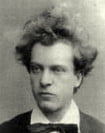 Hans Rott Our Summer Workshop is an occasion when the orchestra spends a day rehearsing an interesting work then gives an early evening informal performance which audiences may attend at no charge, although a collection is made to help cover our costs. The rehearsal is open to non-member players (who should apply beforehand) and spectators, including (silent) children. The work to be studied this year is the Symphony in E by Hans Rott, 11:00 – 12.00 Strings only rehearsal 12:00 – 13:00 Full orchestra rehearsal 13.00 – 14.00 Lunch (Please bring your own picnic lunch – weather permitting, lunch can be eaten outside) 14.00 – 15.30 Rehearsal 15.30 – 16.00 Break 16.00 – 17.30 Rehearsal 17.30 – 18:00 Break 18:00 – 18.15 Introductory talk to audience with possible extracts 18.15 – 19.15 Performance | |||||||||
Concert Saturday 19th May 2012 at 7:45pm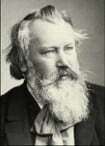 Johannes Brahms
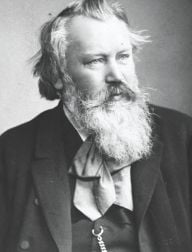
Walton Two pieces from ‘Henry V’ Strauss Horn Concerto No. 2 Massenet Méditation from Thaïs Brahms Symphony No. 4 Rossini’s overture is very well known, not least for its galloping finale which became the ‘Lone Ranger’ theme music. Music for strings from Walton’s ‘Henry V’ film music calms things down. Strauss’s love for the horn shines though all his orchestral works, and particularly in this late concerto which needs a real virtuoso soloist. We conclude our season with this wonderful symphony, which has been a mainstay of the orchestral repertoire ever since it was written. Rossini: Overture ‘William Tell’ Overture Walton: Two pieces from ‘Henry V’ Henry V Suite 2 – Passacaglia: The Death of Falstaff Henry V Suite 4 – Touch her soft lips and part Richard Strauss: Horn Concerto No. 2 Allegro Andante con moto Rondo (Allegro molto) Massenet: Méditation from Thaïs Méditation Bernard Brook tribute Brahms: Symphony No. 4 Allegro Non Troppo Andante Moderato Allegro Giocoso – Poco Meno Presto Allegro Energico e Passionato – Più Allegro | |||||||||
Concert Saturday 17th March 2012 at 7:45pm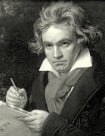 Ludwig van Beethoven
Beethoven Piano Concerto No 5 ‘The Emperor’ Bartók Concerto for Orchestra Borodin’s wonderful music is very widely known, much of it having been adapted for use in lighter and popular genres, notably in the musical ‘Kismet’. For Beethoven’s most well loved piano concerto, we are delighted to welcome back Masa, whose previous appearances with us met with such enormous acclaim. Bartók certainly puts the various sections of the orchestra through their paces in his showpiece concerto, a true 20th Century classic. | |||||||||
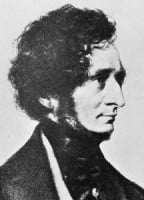
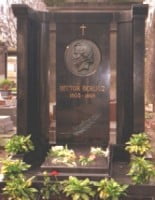
Concert Saturday 21st January 2012 at 7:45pm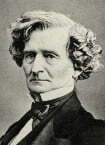 Hector Berlioz
Elgar ‘Sospiri’ Arnold Clarinet Concerto No. 2 Berlioz ‘Symphonie Fantastique’ For 2012, the Queen’s Diamond Jubilee year, we open with Walton’s 1937 coronation march. The poignant ‘Sospiri’ (sighs) cools the mood, ready to be revived by Arnold’s jazzy concerto, originally written for Benny Goodman. In 1830 Berlioz took the musical world into new realms with his vivid picture of passionate but unrequited love that eventually turns into a wild nightmare. | |||||||||
Saturday 12th November 2011 at 7:45pm
| |||||||||
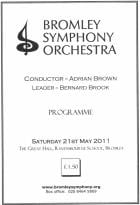
Saturday 21st May 2011 at 7:45pm
| |||||||||
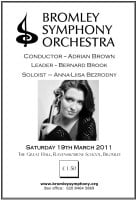
Saturday 19th March 2011 at 7:45pm
| |||||||||
Saturday 22nd January 2011 at 7:45pm
| |||||||||
Saturday 13th November 2010 at 7:45pm
Beethoven: Overture ‘Coriolan’ Berlioz: ‘Reverie et Caprice’ Mahler: Symphony No 5 Second Movement Scherzo Adagietto Rondo Finale | |||||||||
Sunday 13th June 2010
| |||||||||
Saturday 22nd May 2010 at 7:45pm
Kabalevsky: Overture ‘Colas Breugnon’ Tchaikovsky: Piano Concerto No.1 Movement 2 Movement 3 Prokofiev: ‘Romeo and Juliet’ The Young Juliet Scene Madrigal Minuet Masks Romeo and Juliet: Love Scene Death of Tybalt Romeo at Juliet’s Grave | |||||||||
Saturday 20th March 2010 at 7:45pm
| |||||||||
Saturday 23rd January 2010 at 7:45pm
Elgar: ‘In the South’ Strauss: ‘Four last Songs’ September Beim Schlafengehen (Falling Asleep) Im Abendrot (At sunset) Dvořák: Symphony No.8 Adagio Allegretto grazioso – Molto vivace Allegro ma non troppo | |||||||||
Saturday 14th November 2009 at 7:45pm
Berlioz – Overture to ‘Benvenuto Cellini’ Bruch – Violin Concerto Wagner – Prelude and Liebestod from ‘Tristan and Isolde’ Elgar – ‘Enigma’ variations | |||||||||
Sunday 14th June 2009
| |||||||||
Saturday 16th May 2009 at 7:45pm
| |||||||||
Saturday 21st March 2009 at 7:45pm
| |||||||||
Saturday 24th January 2009 at 7:45pm
| |||||||||
Saturday 15th November 2008 at 7:45pm
| |||||||||
Sunday 22nd June 2008
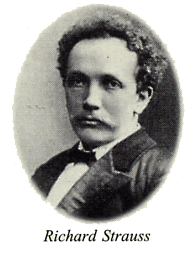
Richard Strauss Alpine Symphony We ran a day’s workshop on Richard Strauss’s epic ‘Alpine Symphony’ at Bishop Justus School. Given its scale and complex scoring, this was not a work that we could ever afford to include in a concert performance, but this was a wonderful opportunity to play this Strauss masterpiece. We spent the day working on it with Adrian before an informal performance in the early evening, which was open to the public. Adrian introduced the work at 5.50pm, followed by an informal performance at about 6.10pm (ending around 7pm). The session was free, but donations were welcome; no tickets were issued. | |||||||||
Saturday 17th May 2008 at 7:45pm
| |||||||||
Saturday 8th March 2008 at 7:45pm
| |||||||||
Saturday 19th January 2008 at 7:45pm
| |||||||||
Saturday 17th November 2007 at 7:45pm
| |||||||||
Sunday 10th June 2007
| |||||||||
Saturday 19th May 2007 at 7:45pm
| |||||||||
Saturday 10th March 2007 at 7:45pm
Introduction and Beethoven: Egmont Bliss: Movement 1 Bliss: Movement 2 Bliss: Movement 3 Brahms: Introduction and Movement 1 Brahms: Movement 2 Brahms: Movement 3 Brahms: Movement 4 | |||||||||
Saturday 20th January 2007 at 7:45pm
| |||||||||
Saturday 11th November 2006 at 7:45pm
| |||||||||
Saturday 20th May 2006 at 7:45pm
| |||||||||
Saturday 11th March 2006 at 7:45pm
| |||||||||
Saturday 21st January 2006 at 7:45pm
| |||||||||
Saturday 19th November 2005 at 7:45pm
| |||||||||
Saturday 14th May 2005 at 7:45pm
| |||||||||
Saturday 19th March 2005 at 7:45pm
| |||||||||
Saturday 22nd January 2005 at 7:45pm
| |||||||||
Saturday 13th November 2004 at 7:45pm
| |||||||||
Saturday 15th May 2004
| |||||||||
Saturday 20th March 2004
| |||||||||
Saturday 24th January 2004
| |||||||||
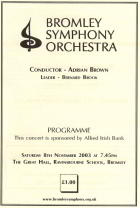
Saturday 8th November 2003
| |||||||||
Saturday 17 May 2003 at 7:45pm
| |||||||||
Saturday 22 March 2003
| |||||||||
Saturday 18 January 2003
| |||||||||
Saturday 9th November 2002
| |||||||||
Saturday 18 May 2002 at 7:45pm
| |||||||||
Saturday 9 March 2002 at 7:45pm
| |||||||||
Saturday 19 January 2002 at 7:45pm
| |||||||||
Saturday 10 November 2001
Tchaikovsky was captivated by his stay in Italy in the winter of 1879-80. His popular Italian caprice begins with a trumpet call he heard every evening from barracks near his hotel in Rome.
Arguably the most melodic of the five symphonies, the fourth was finished in London in 1833 after travels in Italy 1830-31.
Gloucestershire-born Gustav Holst parodies other composers in his one-act comic opera, first produced in London in 1923. In the ballet music, published separately in 1920, we hear the dances of the magical spirits of Earth, Water and Fire.
Respighi’s portrayal of Rome’s pines brings to life pictures of children playing, a mysterious catacomb, a night scene with a nightingale’s song, and a ghostly approaching Roman army marching down the Appian Way. One of three symphonic poems evoking the city of Rome, Respighi uses bold orchestral colours he developed studying with Rimsky-Korsakov during visits to Russia 1900-03. | |||||||||
Saturday 20th May 2000Elgar Introduction and Allegro for Strings Ravel Piano Concerto in G Sibelius Symphony No 5 in E flat Conductor Adrian Brown Dedication To Mr Barrington Pearce Elgar Introduction and Allegro for Strings Allegretto Allegro Ravel Piano Concerto in G Adagio assai Presto Sibelius Symphony No. 5 in E flat Allegro moderato Andante mosso, quasi allegretto Allegro molto Recording produced by Christopher Town (Tel 020 8851 9116) with the assistance of Timothy Yeo of Audio Digital and David Elvin. | |||||||||
Saturday 20th February 1993Prokofiev Violin Concerto No. 2 Op. 63 Tchaikovsky Manfred Symphony in Four Scenes Op. 58 Conductor Adrian Brown Prokofiev Violin Concerto No. 2 Op. 63 Andante Allegro, ben marcato Tchaikovsky Manfred Symphony in Four Scenes Op. 58 Vivace con spirito Andante con moto Allegro con fuoco | |||||||||
Concert 26th March 1990Festival of Arts for Bromley BoroughCarey Blyton Fanfare “Scramble!” Berlioz “La Grande Messe des morts” The Festival Orchestra & Chorus With brass groups from: Conductor Adrian Brown Tenor Piotr Kusiewicz Carey Blyton Fanfare “Scramble!” Berlioz “La Grande Messe des morts” Recording by Christopher Town reproduced with his permission. | |||||||||
Concert 25th May 1964String section concert Guest Conductor Sir Adrian Boult Soloist John Coulling Elgar: Serenade Telemann: Viola Concerto Tomlinson: Two Pieces for Strings Britten: Simple Symphony Hindemith: Trauermusik | |||||||||
Concert Saturday 5th October 1963(String section) Service of music in memory of Marjorie Whyte Ralph Vaughan Williams: Valiant for Truth Holst: Psalm 148 Brahms: Requiem How Lovely Schubert: Psalm 23 Ralph Vaughan Williams: For All the Saints Bach: Violin Concerto in E Major |

 Franck

 Rawsthorne
 Berlioz
 Dvořák Scherzo Capriccioso
 Beethoven Symphony 6 ‘Pastorale’
 Reinecke Flute Concerto
 Smyth The Wreckers
 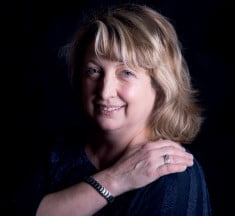 In honour of Vaughan Williams’ 150th anniversary, his atmospheric and monumental Sinfonia Antartica features for November. Elgar’s immortal cello concerto will be performed by Alice McVeigh, herself celebrating 40 years leading our cello section. Smyth’s dramatic overture opens this intensely English concert.








 Mozart Overture to The Magic Flute


 Mozart Symphony No 32 in G Major

 Our composition competition has now ended and the winner is:
 Bernstein Overture ‘Candide’


 Nielsen Symphony No.3

 Márquez Danzón No.2
 Dukas: ‘La Péri’, Fanfare et Poème dansé


 Schumann Overture from Manfred, Op. 115

 Humperdinck Prelude ‘Hänsel und Gretel’
 Walton Overture “Portsmouth Point”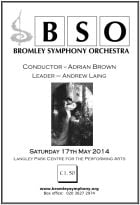























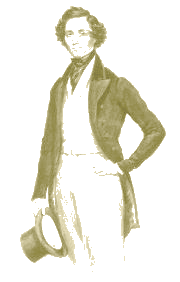 Mendelssohn Italian Symphony